Wednesday, 18 January 2012

Hans Talhoffer's Medieval Warefare Insights are Revealed from Royal Library, Copenhagen


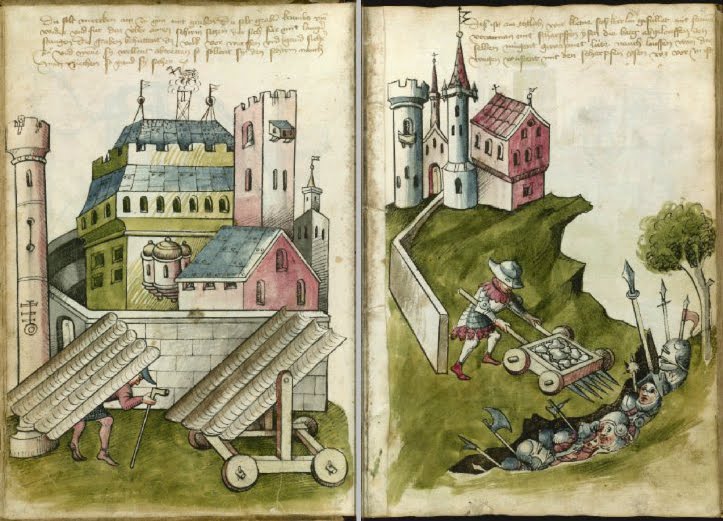
I recently watched a very interesting program about Medieval warfare, which I have to say, I know little about. The National Geographic program; Medieval Fight Book however, unveiled some rare insights into the strategies and methods of combat during the 15th C, which revealed some surprising evidence of new war machines, weapons and the means by which even a woman could compete in and win a battle.


http://www.aemma.org/onlineResources/talhoffer1459/contents_body.htm

http://www.kb.dk/da/nb/materialer/haandskrifter/HA/e-mss/thalhofer/thott-2_290.html

Thursday, 12 January 2012

National Geographic unveils New Discoveries behind the Staffordshire Hoard


Last night, the National Geographic channel aired the first behind the scenes insight into the revelations of the Staffordshire Hoard, as it is slowly conserved and researched at institutions across England and Europe.

The program previewed some of the artifacts found in the 3,500 piece collection and showcases some of the further discoveries that have been made since the unparalleled collection was unearthed by metal detectorist Terry Herbert in 2009.

Professionals and historians, namely Curator Dr David Symons, Dr Kevin Leahy; Anglo Saxon Metal Work expert, Lead Conservationist; Deborah Cane and Anglo Saxon Craft Specialist; Dane Roper, from the Birmingham and Stoke Museums and the British Museum, explore some interesting theories behind the Hoard's reason for being, its craftsmanship, its provenance and its ultimate end in the field in which it was found in the Staffordshire countryside 2 years ago.

The team of experts seem to have discovered that the majority of the Hoard is made up of artifacts to do with war and warfare in its true sense, in that, the artifacts are not only extremely decorative, but also made with a lethal and effective purpose to the destruction of enemies.

New breakthroughs after conservation of some of the artifacts indicate how and where the objects were made. The ruby red garnets, which brightly adorn many of the artifacts found in the Hoard, are thought to have been sourced from Europe and Asia. Through research conducted at the Louvre museum using a Particle Extractor, the researchers found that the chemical composition of the gemstones could be linked to those found in the geographical areas of Sri Lanka and the old kingdom of Bohemia, now the Czech Republic. The program also showcases a collection of 7thC tools, found just 100 miles away from the Hoard's location, that are thought to be similar to the tools used by the craftsmen of the Staffordshire Hoard. This has shed light on the production of the beautiful high grade metalwork, which is consistently accomplished across the collection.

Similar scientific technologies have been utilised at the British Museum to determine more about the type of gold used in the pieces of the Hoard. Dr Symons believes that the gold must have been sourced from the Byzantine Empire, that in the 6thC held a treasury of 400,000 lbs in weight of gold. The Staffordshire Hoard's gold totals 11lbs in weight.

The apparent difference in the colour of gold between each object and the discolourations within each object, suggested impurities with the gold used. These impurities signify the composition of the gold and specific compositions can be linked to geographical locations where the gold has originated. In the same way that the Particle Extractor was used for the garnets, the British Museum used X Ray Florescence to determine the different elemental compositions of each artifact within the collection.

The X Ray's revealed there were impurities from other metals such as silver, in the gold. This most commonly occurred when gold was melted down and other metals were introduced for reuse. This could mean that the gold used for the artifacts in the Staffordshire Hoard may have been taken from existing pieces that were melted down and salvaged. Other signs of recycling throughout the Hoard are seen in the use of ancient Roman glass and mosaic that appear in some of the objects, indicating the Anglo Saxon's resourcefulness.

The indication that the gold had been melted down from another source in order to create the objects found in the Hoard, has lead to some questions about the original source of the gold. If the gold did come from the Byzantine Empire, as Dr Symons suggests, then the program explored the possibility of the gold coming from Byzantine gold coins. It is estimated that it would have taken 3000 gold coins to create the amount of gold needed for the objects found in the Staffordshire Hoard. As gold coins were a rarity during the Anglo Saxon period, this theory seems to be unfavorable. The next hypothesis is that the gold has originated as other forms of sword hilts and spoils of war from Byzantium. It would then have been brought over to England and reworked to result in the stunning artifacts we see today. This would also support the time-line within the pieces of the Hoard itself, which span at least 150 years. The earliest piece in the collection is estimated to date around 550bc and the latest date, between 680-700bc, with an early Christian Cross estimated as being from the early 8thC.

The context of the surrounding landscape where the Hoard was unearthed, has also been researched. A geophys report into the area produced a pocket of interest near to where the Hoard was located. Although this didn't produce a barrow or ditch as the experts were hoping, a survey of soil samples were taken by Environmental Archaeologist Dr Ben Geary of a cross section of the the plants and insects surrounding the area at the time. Dr Geary and his team produced a report of the pollen, revealing the area was on a high ground of heathland and encompassed by a densely wooded area. Therefore it seems that the Hoard was buried in a distinct visual island that would have been easily recognisable and relocated.

Questions must still remain then, as to who would bury such a treasure and why no-one ever returned to claim it.

The program will air again on Monday 16th of January on the National Geographic channel at 2pm. You can go to visit the Hoard at both the Birmingham Museum and Art Gallery and The Potteries Museum and Art Gallery in Stoke on Trent. You can also keep up to date with the conservation of the Hoard and any new discoveries by logging onto or subscribing to their blog; http://www.staffordshirehoard.org.uk/blog/research

Photo's courtesy of Robert Clark.

http://www.staffordshirehoard.org.uk/

http://www.robertclarkphoto.com/

http://natgeotv.com/uk/saxon-gold-new-secrets-revealed/about

http://ngm.nationalgeographic.com/2011/11/gold-hoard/clark-photography#/01-staffordshire-treasure-3500-pieces-670.jpg

http://video.nationalgeographic.com/video/player/national-geographic-channel/all-videos/

Sunday, 8 January 2012

Television that offers Illumination on the Kings of the Dark Ages


Illuminations: The Private Lives of Medieval Kings is a new series about to start on BBC4 tonight at 21:00 and will continue into next week. The series concentrates on the British Library's Royal Manuscripts Illumination collection and delves into the great illuminations through the Medieval period to discover their meaning, symbolism and creation.

Episode One; Ruling by the Book:

Dr Janina Ramirez unlocks the secrets of illuminated manuscripts that were custom-made for kings and explores the medieval world they reveal. She begins her journey with the first Anglo-Saxon rulers to create a united England, encountering books in the British Library's Royal manuscripts collection which are over a thousand years old and a royal family tree which is five metres long.

Janina finds out about a king who had a reputation for chasing nuns and reads a book created as a wedding gift for a ten-year-old prince. She roams from Westminster Abbey to other ancient English spiritual sites such as Winchester, St Albans and Malmesbury, and sees for herself how animal skins can be transformed into the finest vellum.
The British Library's exhibition; Royal Manuscripts. The Genius of Illumination, began in November 2011 and will continue until 13th March 2012.

Dozens of medieval manuscripts from the Royal and other British Library collections will be featured in a television series to air on BBC Four, beginning next week. Presented by art historian Dr Janina Ramirez, Illuminations: The Private Lives of Medieval Kings is a three-part series examining in detail what these manuscript treasures can reveal about the hidden lives of England's monarchs.

The series was produced as part of The British Library's ongoing collaboration with the BBC, and in conjunction with our exhibition of manuscripts from the Royal collection. Many of the manuscripts featured have never before appeared on film (a few of our curatorial team will be making their television debuts as well).

Dr Scot McKendrick, Head of History and Classics at the British Library, served as a series consultant on the programmes. He says, 'There is no doubt that this collection held by the British Library provides us all with unique opportunities to explore in-depth the lives of our kings from the medieval period. The beauty and ingenuity of these manuscripts, that have stood the test of time, also tells us a great deal about a relatively forgotten period of our history. We are delighted to be telling this fascinating story through the British Library's exhibition and through this mesmerising series with BBC Four.'

The first episode, called Ruling by the Book, will air on BBC Four on Monday 9 January at 21:00, and will also be available after the broadcast on BBC iPlayer.

Further information is available from the British Library's press release, and there is also a review of the programme in the Daily Mail. This review ends with a reference to the long-running debate over whether or not gloves should be worn by curators handling illuminated manuscripts, a topic previously discussed in our blog.

The Library, in keeping with the latest cultural trend to attempt to reach a wider audience, has provided a wealth of information about the exhibition, linking facebook, apps, blogs and online video's to engage with the prospective visitor or interested viewer. The 'Royal App' is actually very interesting and for £2.99 you can access;

• 58 manuscripts from the exhibition, each with interpretive text
• 500 high-resolution manuscript images of some of the best surviving examples of medieval painting in England, including many pages not on display in the exhibition
• 6 expert curator videos exploring the history and details of the manuscripts
• Functionality to star your favourite items and view them together in one place

Selected manuscripts include colourful histories and genealogies, Bibles and Psalters, scientific works and accounts of coronations.

Highlights include:

• Book of Hours made for Margaret Beauchamp (great-grandmother of Henry VIII)
• Henry VIII’s Psalter, commissioned and annotated by the king himself
• Maps of an itinerary from London to Apulia and to the Holy Land
• Shrewsbury book, presented to Margaret of Anjou on her marriage to Henry VI in 1445

Please note, a WiFi connection is required to download the app and to view the videos.

There is also the usual exhibition catalogue to provide substantial academic support. The British Library's website says;
Illuminated manuscripts collected by the kings and queens of England from the 9th to the 16th century form the heart of a unique and visually stunning collection held by the British Library. A key figure in the formation of the collection is King Edward IV (1461 – 1483), who commissioned luxury manuscripts decorated with his arms. Subsequent monarchs added to this library, which was given to the nation by George II in 1757.Over 150 examples from this exceptional collection are presented in this catalogue, which accompanies a major British Library exhibition of the same name. These manuscripts contain paintings produced by some of the finest artists of the Middle Ages and together provide the most vivid surviving source for understanding royal identity, moral and religious beliefs, learning, faith and international politics.The catalogue features a full-page entry of around 750 words on each manuscript included, as well as three illustrated essays which explore the wider history and context of this unique collection. It is lavishly illustrated, with a beautiful reproduction of an image from each manuscript presented alongside the text for every entry.
http://britishlibrary.typepad.co.uk/digitisedmanuscripts/royal/

http://www.bl.uk/whatson/exhibitions/royalman/about/index.html

http://www.bbc.co.uk/programmes/b0192nrg

Tuesday, 19 July 2011

Welock Priory & Buildwas Abbey


http://www.english-heritage.org.uk/daysout/properties/buildwas-abbey/#Left

http://www.english-heritage.org.uk/daysout/properties/wenlock-priory/


Tuesday, 5 July 2011

Treasures of Heaven: British Museum displays the sacred relics of Medieval Chistendom


The British Museum has opened its latest Block Buster Exhibition entitled 'Treasures of Heaven' which is on display from 23rd of June until the 9th of October 2011 and will encompass for the first time, more than 150 objects of reverie and reliquary loaned from renowned world-wide institutions here in Europe and the U.S.

The website, which is prolific in its exhibition information for this event, describes the exhibition;

Treasures of Heaven

Saints, relics and devotion
in medieval Europe

This major exhibition brings together for the first time some of the
finest sacred treasures of the medieval age.

The exhibition features over 150 objects from more than 40 institutions including the Vatican, European church treasuries, museums from the USA and Europe and the British Museum’s own pre-eminent collection.

Where heaven and earth meet

It was during the medieval period that the use of relics in devotional practice first developed and became a central part of Christian worship. For many, the relics of Christ and the saints – objects associated with them, such as body parts or possessions – continue to provide a bridge between heaven and earth today.

Sacred containers

Relics were usually set into ornate containers of silver and gold known as reliquaries, opulently decorated by the finest craftsmen of the age. They had spiritual and symbolic value that reflected the importance of their sacred contents.

Over a thousand years of history

The earliest items date from the late Roman period and trace the evolution of the cult of the saints from the 4th century to the peak of relic veneration in late medieval Europe.

Relics featured in the exhibition include three thorns thought to be from the Crown of Thorns, fragments of the True Cross, the foot of St Blaise, the breast milk of the Virgin Mary, the hair of St John the Evangelist, and the Mandylion of Edessa (one of the earliest known likenesses of Jesus).

Witness a lost heritage

Treasures such as these have not been seen in significant numbers in the UK since the Reformation in the 16th century, which saw the wholesale destruction of saints’ shrines. The exhibition offers a rare opportunity to glimpse the heritage of beautiful medieval craftsmanship that was lost to this country for centuries.

The eclectic website includes a blog where you can follow the behind the scenes progress from curator James Robinson and his team, a multi-media presentation, an online book shop and ticket booking service, excerpts from the exhibition catalogue which are free to download and additionally there are links to networking sites such as twitter and Facebook.

All this pre-exhibition information that is available for the visitor seems to verify the latest developments in the management of 'the block buster' exhibition trend for eminent Museums and Galleries. It seems they are trying to turn the tide of 'Gallery Rage' experienced by a visitor who is often bustled into an exhibit where viewing is limited and of short duration due to the numbers of other visitors all crowding in.

As we saw with the National Gallery's preparation for the forthcoming Leonardo Da Vinci exhibition, it seems the more information and context the institution can provide to the the avid voyeur before their visit, the better their exhibition experience will become. Although the British Museum has not mentioned any restrictions on numbers allowed into the exhibition space at any one time, as the National Gallery have done, the hope seems to be that equipped with as much information about the objects and artefacts as possible, a visitor to the British Museum will enjoy a greater sense of the display and less a sense of being herded through a money making show.

After being open for a week, it seems that not only art lovers have been flocking to see these rare insights into the Medieval religious mind. Religious visitors too, are flocking to see the exhibition with one member of staff describing himself as being; "knee deep in archbishops".

http://www.britishmuseum.org/whats_on/exhibitions/treasures_of_heaven.aspx

http://www.guardian.co.uk/artanddesign/jonathanjonesblog/2011/jun/30/treasures-of-heaven-kiss-relics?INTCMP=SRCH

http://blog.britishmuseum.org/category/exhibitions/treasures-of-heaven/

http://www.nationalgallery.org.uk/whats-on/exhibitions/devotion-by-design

http://www.learn.columbia.edu/treasuresofheaven/relics/Arm-Reliquary-of-the-Apostles.php

http://www.britishmuseum.org/whats_on/exhibitions/treasures_of_heaven/introduction.aspx

http://www.guardian.co.uk/artanddesign/gallery/2011/jun/20/treasures-of-heaven-british-museum-in-pictures

http://www.guardian.co.uk/culture/2011/jun/28/british-museum-top-attraction

Tewkesbury Medieval Festival this Weekend!


This weekend sees the little town of Tewkesbury in Gloucestershire, adorning its historic cap as it holds the largest medieval festival in Europe over a two day spectacular.

Tewkesbury is a small Gloucestershire market town standing at the confluence of the rivers Severn and Avon. It has a magnificent Abbey - now the Parish Church and the second largest in the country. It also has a wealth of medieval buildings and is so well preserved it is one of just six 'gem' towns in the country. Every summer the town centre is decorated with colourful medieval banners, based on those carried in the battle of Tewkesbury.

Now in its 25th year, this completely volunteer organised event, is more popular than ever with locals and historians alike, as the whole town becomes involved in the festival which, centers around the re-enactment of the Battle of Tewkesbury won in 1471.

The battle was the last in the battle of the Civil War of the Roses and took place on May 4th 1471. Both the Houses of York (the White Rose) and Lancaster (the Red Rose) fought viciously to prove who should be King.

The War of the Roses began because Henry VI was considered insane and the country was without a strong leader. Edward of York was believed to be the most able leader left and was was declared King in 1461. He had Henry locked in the tower of London so his wife Margaret of Anjou fled to France with their son who was also called Edward.

When Edward reached 18 Margaret decided to return to England and re-claim the throne for her son. She landed at Weymouth on April 14, 1471, and set off for Wales, where Jasper Tudor awaited with re-enforcements for her small army. As they approached the city of Gloucester they gathered further support for their cause but King Edward locked the City Gates to prevent their attack.

The next crossing point over the River Severn was Tewkesbury, and though the party hoped to cross the River to safety, Edward's army far outnumbered and out-skilled that of Margaret's, who were, in the end, bitterly defeated. It is said that many tried to flea the scene and cross the River Severn, only to be killed by Edward's men. This has lead the nearby Meadow to be known as 'Bloody Meadow'.

Margaret was lucky and escaped with some of her ladies to a Priory in Malvern, her son Edward however, was killed and buried in Tewkesbury Abbey. The Prince's last resting place is still marked today with a brass plaque, which sits directly beneath a ceiling boss of the Yorkist badge; The Sun in Splendour' within the Abbey.

The Festival promises to be very entertaining and interesting and i'm very much looking forwards to visiting this event for the first time. The website lists the events program:-

Saturday

  • 11am - Festival opens.
  • 11:45am - Mayors Party, with Colchester Watch arrives.
  • 12 noon - Official opening by our patron, actor and historian Robert Hardy, outside the public information tent, next to the Black Bear Banner.
  • 12 non - Archery competition for re-enactors, in the amphitheatre on Windmill Hill.
  • 3pm - Falconry display on the battle arena.
  • 3:15pm - Troops start to muster for battle.
  • 4pm - Battle re-enactment.
  • 6pm - Festival site closes and events move into town.
  • 7pm - Re-enactment of the storming of the Abbey.
  • 7.30pm - Trial and be-heading of captured Lancastrians followed by Compline (in the Abbey) and presentation of the Tewkesbury Indenture.

Sunday

  • 9:15am - Eucharist led by the Vicar of Tewkesbury Abbey at the Kings Camp.
  • 11am - Festival site opens.
  • 11.30am - Guided walk around the battle field.
  • 12 noon - Archery competition.
  • 1.30pm - Guided walk around the battle field.
  • 2pm - Falconry display on the battle arena.
  • 3pm - Battle re-enactment.
  • 5pm - Festival ends.

Battlefield walks

Regular guided tours of the battlefield, are conducted during the festival, with a full description of the events leading up to the Battle of Tewkesbury, the conduct of the battle, and the aftermath. These walks are taken at a leisurely pace, and last about two hours.

The walks are organised by the Tewkesbury battlefield Society, which exists to promote knowledge of the battlefield.

Program of events and activities

Tewkesbury Medieval Festival includes a huge re-enactment of the Battle of Tewkesbury, featuring around 2000 warriors, including knights in full armour, gunners, with cannon and hand guns, archers, with the traditional English Longbow, and men at arms with swords, spears and other weapons of the period, all brought to life with a lively and informed commentary, and taking place on part of the site of the original battle of 1471.


The battle in full swing

When not fighting many of them will be living for the weekend as soldiers on the march, sleeping in authentic medieval tents, eating food of the period, cooked over open fires in copies of medieval pots and pans, and preparing for the battle as they would have done in 1471.

Many of the traders on our market are just as authentic, dressed 15th century traders, they use well researched skills to do everything from making swords and armour, to preparing ginger bread and hand stitching beautiful gowns and colourful tunics.


Medieval entertainer

Outside of the battlefield

Throughout the summer the main streets of Tewkesbury are decorated with banners displaying the arms of some of those who fought in the battle and the event co-incides with the town's entry into The Heart of England in Bloom. Look out too for colourful floral displays and specially decorated windows.

A number of events connected with the festival also take place in the town. Notably the parade including the Colchester Watch, with their Mayor and ours mustering in the Black Bear at ten to ten to march to the site, our tithe collectors will be demanding money of the traders.

There is always a worry that events such as this might verge into the romantic elements of Medieval history, with a possible New Age feel but i shall report back next week and we shall see!

Please visit the website to make a donation, view maps and see the history of the Battle and Festival in full:-

http://www.tewkesburymedievalfestival.org/index.html

Wednesday, 22 June 2011

Medieval Treasure Found in Lancashire


A lucky metal detectorist from Lancashire has unearthed a medieval pilgrimage relic which will take its place amongst some of the most rare and revered Medieval Relics in an Exhibition at the British Museum.

The exhibition 'Treasures of Heaven' which opened last week and is on until 9th October, will for the first time bring into context, these sacred and mystical treasures from the Middle Ages.

The Guardian's Maev Kennedy reports;
The badge made of silver found by Paul King, a retired logistics expert, is a humble object to earn a place in an exhibition called Treasures of Heaven, but it is unique. It will sit among gold and silver reliquaries studded with gems the size of thumbnails – or the sockets from which they were wrenched by thieves – once owned by emperors, popes and princes.The badge, the only one of its kind ever found in Britain, provides a link 500 years ago between this corner of rural Lancashire and the great pilgrimage sites of mainland Europe. It shows one of the companions of St Ursula, one of the most popular mystical legends of medieval Europe...

King, a member of the South Ribble metal detecting club, found the silver plaque at the end of April in a field some miles from his home in Walton-le-Dale, where he had already found several hundred Victorian coins, but returned with the blessing of the landowner for a sweep with his new more high-powered metal detector.

"I knew immediately she was something special," he said. "I think she was hidden deliberately – she was folded over, not damaged by a plough strike in any way. It is extraordinary and moving to think how much history is locked up in this little piece of metal."

Though there are many variations, the story of St Ursula which was recorded by Jacobus de Voragine’s in his Legenda Aurea (Golden Legend) of 1266, is that Ursula was a British Princess who was offered her hand in marriage by a pegan king. It is said that Ursula managed to delay the betrothal for 3 years during which time she had pleaded with her father to let her go on pilgrimage to Jerusalem.

Ursula was accompanied by 10 ladies in waiting and each lady had 1,000 virgins who accompanied them on their Holy pilgrimage across Europe.

After meeting Pope Cyriacus in Rome the ladies returned home and in Cologne, were stopped, besieged and eventually beheaded by the Huns. The Legend says that St Ursula was shot with an arrow, which is why most depictions of the Saint portray her holding a single arrow in one hand to demonstrate her means of Martyrdom.
The Legend says that some date this event to 238 but that the year 452 is more likely.

The story originated in a local tradition in Cologne that some number of Christian virgins had been martyred by the Romans in the early years of the city. The earliest testimony to these virgins is a stone inscription from the fourth century, now in the choir of the Church of St. Ursula in Cologne. It speaks only of an unspecified number of virgin martyrs "from the East." But in the ninth century a number of liturgical sources mention these Colognese virgins, reporting their number variously as five, eight, or eleven. Scholars are uncertain as to how the number eleven was chosen and then multiplied by a thousand.
Maev Kennedy writes further;
Although a church in Cologne holds her shrine and a whole chapel still decorated with the supposed bones of her companions, there were so many bones that the relics spread across Europe and beyond. Some of the most beautiful reliquaries, life sized busts of fashionably dressed young women, were made to hold the bones. The badge from Lancashire is a representation of just such a shrine - and so close in style and early 16th century date that it may come from the same Bruges workshop as the one in the exhibition on loan from the Metropolitan Museum in New York.

The Metropolitan reliquary, of a gently smiling young woman with her hair in a modish plaited style, is so alluring it has become the exhibition poster. The badge would have been bought as a souvenir by the Lancashire pilgrim from just such a shrine.

British Museum curator James Robinson said he was "beside myself with excitement" when he saw an image of the find. "To be honest if I hadn't been working on the exhibition it might have taken me a while to clock it – as it is I recognised her immediately as one of the companions of St Ursula. I hesitate to call it a miracle, but it is a most extraordinary coincidence that this should turn up just at this time."

He believes it is even possible that a similar reliquary may have been the centre of a shrine in Britain, destroyed as the cult of relics was condemned as idolatrous and blasphemous by religious reformers.

"The badge may be the only fragile, ephemeral piece of evidence for a cult of St Ursula in the north of England, that might have had at its centre a bust reliquary of continental manufacture."

The exhibition will include reliquaries which the faithful believed once held the breast milk of the Virgin Mary, the umbilical cord of the baby Jesus, the arm of Saint Luke - holding a golden pen to symbolise the gospels he wrote - and many still containing fragments of wood claimed to come from the cross on which Christ died. A carved icon of the Virgin which according to tradition was taken from the neck of the dead emperor Charlemagne, was one of the treasures of Aachen cathedral until it was given as present to Napoleon's Josephine. Some of the loans have never before left the churches or villages where they have been venerated for centuries. Many were believed to have miraculous powers, and made the places that held them wealthy pilgrimage sites - as Canterbury cathedral was for the relics of the martyred Thomas a Becket, and Santiago de Compostela in Spain remains to this day.

King, who has always been interested in history and spends days researching his finds in museums and archives, reported it under the Portable Antiquities scheme which encourages metal detectors to report all their archaeological finds, but she proved to be silver and so legally treasure which must be reported. When valued - the price will be shared between King and the landowner - Robinson hopes the British Museum will acquire her to find a permanent resting place in its medieval galleries
The Lancashire St Ursula badge and the Exhibition 'Treasures of Heaven' can be seen at the British Museum. For further information please see the below links:-

http://www.britishmuseum.org/whats_on/exhibitions/treasures_of_heaven/introduction.aspx

http://en.wikipedia.org/wiki/Saint_Ursula

http://www.guardian.co.uk/culture/2011/jun/20/badge-dug-field-medieval-treasure?INTCMP=SRCH

http://www.aug.edu/augusta/iconography/ursula.html

http://www.liverpoolmuseums.org.uk/online/exhibitions/faith/stursula.asp

http://www.fordham.edu/halsall/basis/goldenlegend/index.htm

Wednesday, 15 June 2011

New Turin Shroud Speculation; Was Giotto its Creator?


The Shroud of Turin, has for centuries, created a mass of speculation and myth around its creation and authenticity; the latest of which, seems to disallow for any recent research into the carbon dating of the cloth of the Shroud, and instead propels renaissance artist Giotto into the spotlight as its cunning creator.

The commonly known 'lunatic fringe' of researchers into the relic's provenance have, in the past, linked Leonardo Da Vinci to the Shroud, suggesting that the image on the cloth is an early photo-generated image from Leonardo's experimental art studios...

This new theory seems to be clinging onto the already disproved argument, that the images on the cloth are made with paint. Artist and restorer Luciano Buso claims to have solved the allusion of the Shroud, and in good old fashioned speculative enthusiasm, has used mysterious hidden names and secret numbers to determine his conclusion.

For those who are unclear as to the history of the Shroud, here's a quick run down of recent research into its authenticity; Said to be the very cloth that Christ was swathed in after Crucifixion, the Shroud of Turin currently lies in Turin's Cathedral as a very real relic of Christianity.

In 1979, a world renowned forensic, Walter McCrone, claimed that he had found paint on the fibers of the cloth. This backed up the local legend that the Shroud had first appeared in 1356 in the hands of a French knight. The Shroud was subsequently called a fake by a local Bishop who claimed at the time, that an artist must have ''cunningly painted it''. Later in 1988, a series of very controversial carbon 14 dating tests were carried out on the edge of the cloth, after stipulations agreed with the Church, so as not to damage the relic. These carbon dating results showed that the fibers of the cloth dated to the Middle Ages between 1260 and 1390.

Skepticism as to the reliability of the dating methods used during the carbon dating experiment circulated and came to a head in 1998 after a photograph of the Shroud proved the image on the cloth to be an exact negative of a human face, and was therefore unlikely to have been painted on. This then called into question how the image was formed and furthermore, whether the carbon dating for the edges of the cloth were accurate.

The image was believed to be a chemical reaction from an embalming ointment applied to the skin of a person, which had 'caramelised' and reacted to the cloth over time.

The bloodstains

The bloodstains on the Shroud of Turin are composed of hemoglobin and give a positive test for serum albumin. Numerous tests confirm this.

The images

The Shroud of Turin's images are superficial and fully contained within a thin layer of starch fractions and saccharides that coats the outermost fibers of the Shroud. The color is a caramel-like substance, probably the product of an amino/carbonyl reaction. Where there is no image, the carbohydrate coating is clear. There is also a very faint image of the face on the reverse side of the Shroud of Turin which lines up with the image on the front of the cloth. There is no image content between the two superficial image layers indicating that nothing soaked through to form the image on the other side.

Until recently, it was widely believed that the images on the Shroud of Turin were produced by something which resulted in oxidation, dehydration and conjugation of the polysaccharide structure of the linen fibers. This is incorrect. The coating, whether imaged or clear, can be reduced with diimide or removed with adhesive leaving clear cellulose fiber.

The images as they appear on the Shroud of Turin are said to be negative because when photographed the resulting negative is a positive image.

The Turin Shroud was examined with visible and ultraviolet spectrometry, infrared spectrometry, x-ray fluorescence spectrometry, thermography, pyrolysis-mass-spectrometry, laser­microprobe Raman analyses, and microchemical testing. No evidence for pigments (paint, dye or stains) or artist's media was found anywhere on the Shroud of Turin - www.shroudstory.com

The carbon dating to the Middle Ages is also questioned as the medieval fibers which were tested have now been found to be mixed with earlier fragments of cloth in a commenly used repair method called 'invisible mending'. This is where new fibers of the cloth are woven with the old fibers so minutely that a repair is not visible to the untrained eye.

So, Mr Buso's theory, as you can see, is somewhat out of date. Nevertheless, if the Shroud is believed to be medieval, and that the image has been painted onto the cloth, and it has been proven that the image on the Shroud is in the negative, then it must have taken an extraordinary artist to complete the task, and Mr Buso believes that artist to be Giotto.

Nick Squires from the Telegraph reports:

Luciano Buso claims to have found Giotto di Bondone's signature hidden in the 14ft-long, sepia-coloured burial cloth, as well as the number 15.

The historian believes that the number is a reference to 1315, and that the artist was commissioned in that year to come up with an exact copy of the relic because the original was badly damaged after centuries of being hawked around the Holy Land and Europe.

Mr Buso, who has laid out his controversial thesis in a new book, said the idea that the existing shroud was created in 1315 agrees with modern carbon dating tests which dated the fabric to the early 14th century.

He told The Daily Telegraph that he believes the original was indeed the sheet used to cover Christ's body but that it disintegrated, or was lost or burned, sometime after the copy was made.

After months of analysis, he claims to have found several 15s and Giotto's name hidden in the imprint of Christ's face and hands – a means by which the artist stamped his mark on his work.

Jonathan Jones of the Guardian responds as to why Giotto could have been up to the task;

Well, Giotto had the genius for it, that much is true. He could probably have knocked up a shroud or two in his lunchtime, if he felt like it. But why would he want to? Nothing in what is known of his life or art suggests any such activities or interests. "Cimabue used to think he led the field," says his contemporary Dante in The Divine Comedy, referring to the great Florentine painter who discovered the artist's talent. But now Giotto has eclipsed him.

Giotto was the most emotionally eloquent painter of his age; he gave people expressions, gestures and statuesque figures that convey, to us as much as to his contemporaries, the deepest human passions. This was a time of great new energies and ideas. Towns and cities were full of pride and wealth, an urban world beautifully captured in Ambrogio Lorenzetti's depiction of medieval Siena. Meanwhile, the vision of Saint Francis of Assisi liberated religion from obscurities and spoke directly to hearts and souls. Giotto's art is as lucid as a Franciscan sermon, and it depicts the ordinary, unaffected faces of merchants, artisans, women and priests. You see its power in his portrayal of the death of Saint Francis in a fresco in the church of Santa Croce, Florence.

Looking at these paintings and considering the claim that Giotto created the Turin Shroud, the question is why our culture needs such a daft story to get us talking about him. Giotto was a deeply serious artist. His achievement, fulsomely recognised in the Renaissance, was to ground painting in the observation of nature, to free it from obscurities, to make it human and real. Beside his paintings, the idea of Giotto taking time off to concoct a relic seems silly. He was too well-known, too ambitious and too profound to either want to do it or get away with it unnoticed.

http://www.telegraph.co.uk/news/worldnews/europe/italy/8561812/Turin-Shroud-the-creation-of-a-Renaissance-artist.html

http://www.shroudstory.com/

http://en.wikipedia.org/wiki/Shroud_of_Turin

http://www.guardian.co.uk/artanddesign/jonathanjonesblog/2011/jun/09/giotto-paint-turin-shroud

A Medieval Lute Luxury: The Gift of Music CD Review

Another lovely CD from The Gift of Music website - www.thegiftofmusic.com

They have a great variety of heritage music on offer, this being one of them. I think the website and musician describe the ambiance of the CD the best;
Travels with my Lute - Lynda Sayce Ref: CDG1114

Travels with my Lute

Fine Renaissance music

The gentle lute: played by one of Britain's leading virtuosos, Lynda Sayce, this programme draws together the best lute music of the Renaissance, contrasting the different regional musical styles which emerged during the golden period of lute composition. Played on a variety of different lutes as appropriate.

Italy
six course lute
1 Fantasia Marco da L'Aquila (fl. XVIth century)
Munich, Bayerische Staatsbibliothek, Mus Ms 266
2 Calata alla spagnola detto terzetti Joanambrosio Dalza (fl. 1508)
3 Pavana alla Ferrarese
4 Saltarello
5 Piva
Dalza, Intabulatura di Lauto. Libro Quarto. Venice 1508
6 Fantasia Petro Paulo da Milano (fl. XVIth century)
7 Tocha tocha la canella Anonymous/ Giovanni Antonio Casteliono
Giovanni Antonio Casteliono, Intabolatura de leuto de diversi autori. Milan 1536
8 Ricercar (Ness 51) Francesco da Milano (1497-1543)
Intabolatura de lautto Libro Settimo. Recercari novi del divino M. Francesco da Milano. Venice 1548
9 Ricercar (Ness 40)
Intabolatura de lauto di M. Francesco Milanese et M. Perino Fiorentino. Libro Terzo. Venice 1547


Germany
bass lute
10 Preambel in Re Anonymous
11 Mein Vleis und Mue Ludwig Senfl (c.1486-c.1543) anon. setting
Munich, Bayerische Staatsbibliothek, Mus. Ms. 1512
12 Elslein liebstes Elslein mein Ludwig Senfl
Hans Newsidler, Ein Newgeordent künstlich Lautenbuch. Nuremberg 1536
13 Der Beyrisch Bok Tantz weyss/Der Hupff auff Hans Newsidler (c.1508-1563)
14 Vita in ligno moritur, prima pars Ludwig Senfl
15 König Ferdinandus Tantz/Der Hupff auff Hans Newsidler
Hans Newsidler, Das Ander Buch. Ein new künstlich Lauten Buch. Nuremberg 1549
16 Ein Welscher Tantz Wascha Mesa/Der Hupff auff
Hans Newsidler, Ein Newgeordent künstlich Lautenbuch. Nuremberg 1536


France
six course lute
17 Fortune laisse moy Pierre Attaignant (ca.1494-1551/2)
Pierre Attaignant, Tres breve et familiere introduction. Paris 1529
18 Basse dance 'La Maddalena' - recoupe - tordion
Pierre Attaignant, Dixhuit Basses Dances garnies. Paris, 1530
19 Mille regretz Josquin des Prez (c.1440 - 1521)
1st setting: Pierre Phalèse, Hortus Musarum. Louvain 1552
2nd setting: Pierre Phalèse, Des Chansons Reduictz en tabulature de Luc, Livre deuxiéme. Louvain 1546
20 Tant que vivray Claude Sermisy (1490-1562)
Pierre Phalese, Des Chansons Reduictz en Tablature de Luth, Livre Premier. 2nd edition. Louvain 1547
21 Passemeze Adrian le Roy (c.1520-1598)
A briefe and easye instrution. London 1568 (English translation of a lost French lute book of 1557)
22 Bransle Guillaume Morlaye (c.1510-c.1558)
Uppsala, University Library, MS 412
23 Branle gay Adrian le Roy
Adrian le Roy, Premier livre de tablature de luth. Paris 1551

England
seven course lute
24 Passamezzo Pavan (bass lute) John Johnson (c.1540-1594)
Cambridge, University Library, Ms Dd.2.11
25 Galliard: Muy Linda Anthony Holborne (fl.1584-1602)
Cambridge, University Library, Ms. Dd.5.78.3
26 Almain: The night watch
Willey Park, Shropshire, private library of Lord Forrester, John Welde lute book
27 Jig: Wanton
Cambridge, University Library, Ms. Dd.5.78.3
28 Fantasia a 5 John Dowland (1563-1626)
Cambridge, University Library, Add. Ms 3056
29 Lachrimae
Cambridge, University Library, Ms. Dd.5.78.3
30 Galliard
London, British Library, Hirsch Ms 1353
31 Mr Dowland's Midnight
London, Royal Academy of Music, Ms 603, (The Margaret Board lute book)

Lynda Sayce, lute


CCL CDG1114
P & C 2005 Classical Communications Ltd
Cover image: Young Lute Player by Vittore Carpaccio, detail from
The Presentation of Jesus in the Temple 1510 from S.Giobbe altarpiece, Venice
Lebrecht Music & Arts Photo Library
Made in Great Britain

Inside book:

Travels with my lute
Fine Renaissance music

Lynda Sayce

The lute encapsulates the spirit of the renaissance. It was immortalized in poetry by Ronsard and Shakespeare, and on canvas by Holbein, da Vinci, Titian and Raphael. It was played by Henry VIII and Elizabeth I, Martin Luther and Galileo. Its huge and magnificent repertory is one of the artistic glories of the 16th century, and, true to the spirit of the age, it was constantly being reborn as different cultures adopted it and made it their own.

The earliest lute manuscripts date from years around 1500, when lutenists had only recently adopted the new-fangled technique of plucking with the fingers. The lute was originally played with a plectrum, which largely confined it to playing single lines. Plucking with the fingers made polyphony possible on a single lute, and suddenly lutenist-composers had a subtle and versatile instrument of unrivalled emotive power, uniquely possessing both the chromatic capability of keyboard instruments, and the dynamic and tonal flexibility of the harp. This description of the playing of Francesco da Milano, known as 'il Divino', gives some idea of the lute's power:


The tables being cleared, he chose one and, as if tuning his strings, sat on the end of a table seeking out a fantasia. He had barely disturbed the air with three strummed chords when he interrupted conversation which had started among the guests. Having constrained them to face him, he continued with such a ravishing skill that little by little, making the strings languish under his fingers in his sublime way, he transported all those who were listening into so pleasurable a melancholy that ... they remained deprived of all senses save that of hearing, as if the spirit, having abandoned all the seats of the senses had retired to the ears in order to enjoy the more at its ease so ravishing a harmony; and I believe ... that we would be there still, had he not himself - I know not how - changing his style of playing with a gentle force, returned the spirit and the sense to the place from which he had stolen them, not without leaving as much astonishment in each of us as if we had been elevated by an ecstatic transport of some divine frenzy.

Decades later, the English traveller Fynes Morison noted that

The Italians, and especially the Venetians, have in all tymes excelled [in the Art of Musick], and most at this day, not in light tunnes and hard striking of the stringes, (which they dislike), ... but in Consortes of grave soleme Musicke, sometymes running so sweetely with softe touching of the stringes, as may seeme to ravish the hearers spiritt from his body...

The Germans, on the other hand, 'like them better who strike hard upon the strings, then those who with a gentile touch make sweeter Melody, which they thincke fitter for Chambers to invite sleepe, then for feasts to invite mirth and drincking.' Appropriately enough, German lute collections are replete with lively dances, and German paintings and engravings show a definite preference for large lutes, well-suited to vigorous playing, but also prized for their exquisite sonority. Sadly the wonderful German lute repertory is rarely heard today, because it was written in a particularly tortuous notation system which had no stave but used the entire alphabet twice over, plus several numbers and a few Greek letters too.

The lute was the pre-eminent courtly instrument of mid-16th France, ennobled in verse by the great French poet Ronsard, who hailed it as 'the glory and trophy of Phoebus', capable of curing lovesickness and envious cares. The influential Ronsard admired chanson composers, and Josquin above all, so not surprisingly arrangements (called intabulations) of vocal music are extremely important in French lute collections.

The final flowering of renaissance lute music occurred in England in the latter half of Elizabeth I's reign. English taste eschewed vocal intabulations in favour of dance forms and variation sets. John Johnson (d.1594) was the first major English lute composer. Both he and Anthony Holborne (d.1602) served Elizabeth, the former as one of her 'Musitians for the three lutes', the latter as a gentleman usher. Ironically the greatest English lutenist, John Dowland, was repeatedly denied a court position, perhaps because of his Catholicism but more likely because of his difficult personality. He and Francesco da Milano may be considered the alpha and omega of the renaissance lute, both in terms of their international fame and the longevity of their music.

Lynda Sayce

Lynda Sayce read Music at St. Hugh's College, Oxford, then studied lute with Jakob Lindberg at the Royal College of Music, and also took continuo classes with Nigel North. She holds a Ph.D for her research on the history of the theorbo, which is to be published as two books in 2005-6. Lynda has contributed articles to Early Music, the Revised New Grove Dictionary of Music, and the art journal Apollo, and has edited many music publications. She performs regularly with leading period instrument ensembles, including The King's Consort, the Academy of Ancient Music, the Orchestra of the Age of Enlightenment, and the Musicians of the Globe. For many years she was lutenist with the award-winning ensemble Charivari Agréable. She appears on more than 100 CD recordings, and has broadcast on radio and TV stations throughout Europe, and in the USA, Japan and South America. On this recording Lynda plays lutes by Ivo Magherini (6 course and bass) and Michael Lowe (7 course).

For further information on Lynda and her work, please visit www.theorbo.com

Monday, 9 May 2011

Leonardo in London; Quick or You'll Miss It. Be Prepared!


The Guardian have reported on the forthcoming exhibition, (mentioned previously in this blog) of Leonardo Da Vinci, to be held in the National Gallery, London, as 'the most complete display of Leonardo's rare surviving paintings ever held'. Questions are being asked however, as to whether the 'Block Buster' exhibitions of recent times have come to an end, with the National Gallery placing a limit on admissions. Stephen Moss asks whether the packed crowds, limited viewing of art works and timed entry will become a thing of the past in favour of a more civilised and heightened experience of exhibition viewing.

In the past 12 months or so it has been notable, the comments made by exhibition reviewers and visitors a like, as to the monstrous conditions one has to put up with just to see a temporary show. Pushing swarms of visitors, waiting in line to see a masterpiece, hundreds of camera flashes going off at the art works peril; as if some kind of celebrity were in front of the jostling crowds. It has come to be an expected side effect of wanting to go to see any major exhibition in the U.K and has even been coined with its own terminology; Gallery Rage!

The recent Gauguin exhibition at the Tate Modern has caused a stir in the ethos of the Gallery Block Buster mentality. Although the exhibition (see links below) provided a record high in business for the museum, it was also the most reported on for over crowding and disgruntled visitors who paid, queued and did not see paintings due to the rest of the art loving mass accompanying them in the Gallery.

Stephen Moss reports;

The problem lies with the whole notion of the "blockbuster", which is just a desperately hoped-for money-spinner for cash-strapped galleries. Colin Tweedy, chief executive of Arts & Business, argued recently that the era of blockbuster shows was coming to an end. And he welcomed their phasing out. "The blockbuster model is killing art," he said. "It is not the right way to see great artists. In the next five years, museums will stop doing these exhibitions because they are too much trouble. The blockbuster is an old model. The creators of culture have to think in a different way."

Art shows are like any other aspect of the cultural business. Galleries put together a show, try to create a buzz, hope the exhibition will come to be seen as an "event". The hucksterism is pretty disgusting when you think about it. They've introduced timed tickets to try to even out the peaks and troughs in attendance, but timed tickets are pretty disgusting too. They assume that a two-hour stint is the norm and won't let you back in if you fancy having lunch and then taking another look.

This is, as Tweedy says, no way to see art. It is a branch of commerce devised for the benefit of the gallery, and playing on the exhibition-goer's fantasy that by spending two hours in the company of Gauguin or Leonardo he or she can get a meaningful take on the artist. Far better to go and look at a couple of Gauguins in a gallery and live with them for a while, or go regularly to see the couple of Leonardos in the National Gallery's permanent exhibition.

Galleries which stage blockbuster shows are peddling a myth, and they know it. Like Tweedy, we should welcome the fact that the age of the blockbuster is ending. We need to study more carefully paintings that are readily to hand.
The bad publicity received by the Tate Modern seems to have been a lesson learned for the National Gallery, who have opted to reduce the maximum persons allowed entry per hour, from 230 to 180, but this exhibition will draw crowds of art lovers from all over the world, whether limited numbers or not.

The exhibition is the first and best opportunity to view not one, but seven of the artists masterpieces in one exhibition. The curator of the exhibition, Luke Syson, describes it as an achievement for any Gallery to get just one of Leonardo's 14 authenticated paintings, let alone seven, which he states is 'miraculous'.

In his Guardian article; 'Leonardo da Vinci show at National Gallery to limit visitor numbers', Mark Brown interviews the National Gallery's director, Nicholas Penny, who called the exhibition;

"a great triumph in diplomacy" with paintings leaving galleries in Italy and France for the first time....

The show will focus on Leonardo's paintings and drawings while he was court painter to Milan's ruler, Ludovico Sforza. The National Gallery already has the recently restored Virgin on the Rocks and is being loaned astonishing works to exhibit alongside, including Portrait of a Musician from Milan, Saint Jerome from the Vatican and La Belle Ferronière from the Louvre. There will also be what Syson called "one of the most beautiful pictures that was ever painted by anybody anywhere" as the show's centrepiece – Portrait of Cecilia Gallerani, or The Lady with an Ermine, which is regarded by many as the first truly modern portrait and is being loaned by the National Museum in Krakow...

Then there are the drawings. More than 50 are being borrowed including 33 owned by the Queen that were purchased during the reign of Charles II and left in the bottom of a chest until they were rediscovered in 1778, during the reign of George III.
Those visitors hoping to catch a glimpse of the Mona Lisa however, will be dissapointed as the Mona Lisa was painted during Leonardo's time in Florence and therefore does not fall under the exhibition's brief of Leonardo's court paintings at Milan. Brown adds;
Not that anyone would ask the Louvre for a loan. "The collecting staff there would rather rush round naked than lend it," said Syson
Due to the recent back lash aimed at the Tate for the Gauguin debacle, the National Gallery understandably wants to prepare visitors for the exhibition; what to expect and how to get the best experience out of the event as possible;

    "There is going to be tremendous demand and we have taken a number of unusual steps to try and ensure people are not too disappointed," said Penny. "It is very important that people study our website before they come to the exhibition. They can download all the information that people stand and read beforehand. The whole experience can be properly prepared for."

    ...The show opens in November, but the gallery is giving people plenty of time to book in advance by opening sales on Tuesday. Those hoping to buy tickets on the day are being told they face disappointment. The show will run for only three months because, understandably, the other galleries want their paintings back, but it will be open until 10pm on Fridays and Saturdays and 7pm on Sundays. Opening times will be extended further in the last two weeks.

So with all this in mind; forewarned visitors, pre-planned limited numbers and an advertising machine mill stating 'this is not a block buster' that works at drawing visitors just as well as the block buster 'must - see' campaign does, how will the average art lover prepare themselves for the trial of the gallery visit? The Guardian's Tim Dowling has the answer!

In his article; 'How to beat gallery rage' Mr Dowling gives a few tips on handling the masses;

▶ Go at odd hours. Try first thing in the morning or last thing at night (blockbuster shows sometimes stay open until 9 or 10pm in order to accommodate everyone). Even if it's still crowded, it will be less fraught.

▶ Approach the exhibit non- sequentially. Visitors tend to bunch up at the first few works of art, driven by a sense that they have to see everything in order. Jump ahead to less crowded works, or even follow the whole route backwards. This should stop you suffering from gallery rage, although you may cause some.

▶ Skip the audio tour. The evil voices in your headphones will only tell you to go where everyone else on the audio tour is going. This invariably leads to traffic problems around paintings about which the audio guide has something to say.

▶ Re-contextualise the event. Pretend you've come to see a performance installation about crowd control and the limits of human endurance and that the art on the walls is, if anything, a needless distraction.

▶ Wear a high-visibility vest. It makes you look official; people will be afraid to jostle you.

▶ Cultivate a taste for the overlooked, the offputting, the little understood and the poorly reviewed. Your best hope of seeing a one-off collection of masterpieces in peace comes whenever some critic has the foresight to describe the show as "badly curated".

▶ Take advantage of adverse conditions. Even over-subscribed exhibitions become suddenly accessible during freak snowstorms, transport strikes and violent protests. Watch the news, pick your moment and bring extra water in case you get beaten up or kettled on the way home.

▶ Stay home and watch TV. Someone has to. Don't worry about being a philistine; just be thankful you live in a country where museum overcrowding is an actual problem.

And remember;
don't play the galleries' game by falling for the idea that these big shows are "must-sees". For a start, you can barely see them.
Tickets for the Exhibition go on sale on 10th May 2011, better be quick!

http://www.nationalgallery.org.uk/whats-on/exhibitions/leonardo-da-vinci-painter-at-the-court-of-milan

http://www.guardian.co.uk/artanddesign/2011/may/09/blockbuster-exhibition-national-leonardo?intcmp=239

http://www.guardian.co.uk/artanddesign/2011/may/09/leonardo-da-vinci-national-gallery?INTCMP=SRCH

http://www.guardian.co.uk/search?q=how+to+beat+gallery+rage&target=guardian